Wine at cellar constancy
Updated 7 July 2026 · By The Kitchen Affair atelier · 7 minute read
South Africans build serious cellars in a country that makes serious wine and then, too often, store the good bottles in a kitchen that swings ten degrees between lunch and dinner. Wine asks for four things: constant cool temperature, decent humidity, darkness and stillness. A domestic refrigerator provides none of them well. The real decision is between wine climate cabinets — precise, integrated, immediate — and a conditioned cellar or walk-in wine room for collections that have outgrown furniture. Here is how to think about both, and how the serious houses differ.
What wine actually needs
Constancy beats any single number. A cellar that holds 14°C forever ages wine more gracefully than one that averages 12°C but swings daily — temperature movement expands and contracts the liquid against the cork, and that breathing is what tires a wine early. The classical ageing range sits around 12 to 14°C; serving temperatures differ by style, which is exactly why multi-zone cabinets exist.
The other three conditions are quieter: humidity high enough to keep corks supple, darkness because UV degrades wine through clear glass remarkably quickly, and stillness because constant vibration keeps sediment suspended and, over years, dulls development. Every design decision below is really these four requirements wearing different clothes.
Climate cabinets: precision by the bottle
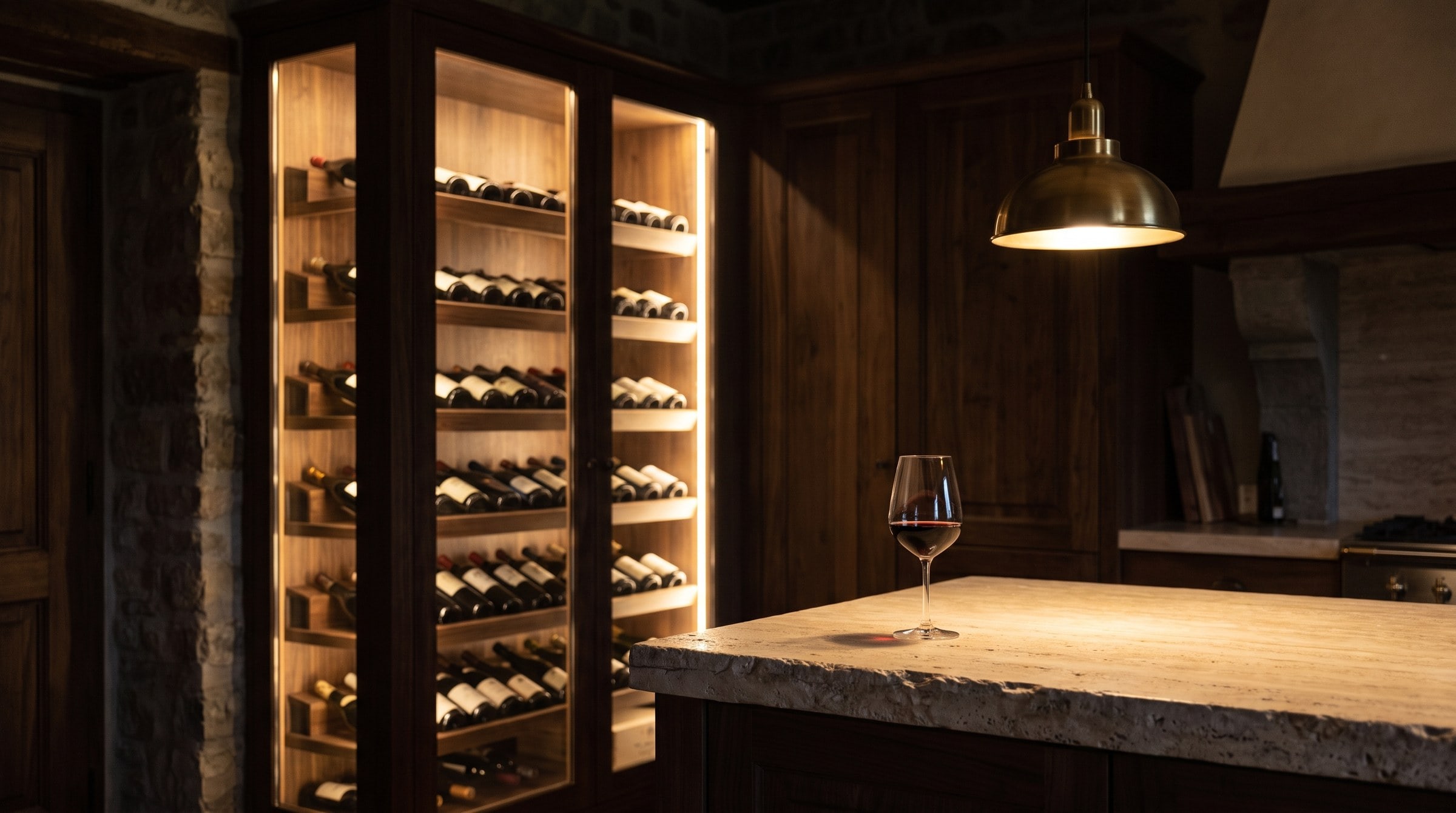
A wine climate cabinet is not a cold fridge with pretty shelves — it is a low-vibration, humidity-managed, UV-filtered instrument holding one, two or three independent temperature zones. Dual-zone is the household workhorse: whites at serving temperature below, reds resting above. Integrated column formats let the collection live where the dining room can admire it.
Liebherr is the volume-and-value reference in South Africa — its dedicated wine ranges carry the house’s refrigeration pedigree at rational prices, with multi-zone options deep enough for genuine collections. Sub-Zero’s wine columns bring the flagship treatment: dual-evaporator climate control and the same preservation obsession as its refrigeration, at apex investment. Gaggenau’s Vario wine climate cabinets are chosen as part of the 400-series architecture — collectors’ instruments finished like the rest of the kitchen. V-ZUG’s Swiss-made cabinets complete the quiet-luxury end of the field.
- Choose a dual-zone cabinet if…
- The collection is under a few hundred bottles and the kitchen or dining space should present it — serving convenience matters as much as ageing.
- Choose integrated wine columns if…
- The kitchen architecture is column-based already and wine deserves the same elevation as refrigeration.
- Choose a conditioned room if…
- The collection is growing past cabinet scale, buying is by the case, and a dedicated space can be insulated and conditioned properly.
Building a collection a home?
An hour with a senior consultant turns reading into a specification. Complimentary, and without obligation.
The conditioned cellar
Past a few hundred bottles, cabinets stop making sense and construction begins. A proper wine room is an insulation project before it is a joinery project: vapour-sealed walls, an insulated door, and a dedicated conditioning unit sized to hold 12 to 14°C against a Johannesburg or Lowveld summer. Get the envelope right and the machinery stays small and quiet; get it wrong and no unit will save it.
In South Africa the practical notes are heat and power. North-facing rooms and garages make expensive cellars; south-side spaces below grade make cheap ones. And conditioning is a continuous load, so put the cellar circuit on the backup system — a week of Stage 6 in February is precisely when the collection needs protecting. The running draw is modest; the design conversation is the same backup-power arithmetic as the rest of the kitchen.
Planning it into the project
Wine storage is a services decision before it is an aesthetic one: columns need dedicated circuits and ventilation clearances, wine rooms need conditioning drainage and insulation thickness that eats floor plan. It belongs in the first design conversation, alongside refrigeration — our integrated refrigeration guide covers the column planning in detail.
Everything serious in this category is price-on-application. Indicatively: quality dual-zone cabinets open the category, integrated columns from the flagship houses sit substantially higher, and a properly built conditioned room is a construction line item in the upper bands of the cost guide. The wine inside usually ends up worth more than the room — which is the argument for building it properly.
Frequently asked questions
What temperature should wine be stored at?
For ageing, a constant 12–14°C — constancy matters more than the exact number. For serving, styles differ: roughly 6–10°C for whites and 15–18°C for reds, which is why dual- and multi-zone cabinets are the household standard.
Is a wine fridge the same as a wine climate cabinet?
No. A basic wine fridge cools; a climate cabinet manages temperature stability, humidity, UV filtration and vibration — the four things that actually protect wine. The difference shows up in bottles opened ten years later.
Cabinet or cellar — at what point does a wine room make sense?
As a rule of thumb: past a few hundred bottles, or when buying shifts to cases meant for a decade, a conditioned room becomes more rational than multiplying cabinets. Under that, a quality dual-zone or column installation serves better and costs far less.
Does load-shedding ruin wine storage?
Short outages are survivable — a good cabinet or well-insulated room drifts slowly. But conditioning belongs on the home’s backup power: its steady draw is modest, and a February week of extended outages is exactly the risk a collection should not run.
Prepared and reviewed by The Kitchen Affair atelier · Johannesburg · Updated 7 July 2026