Gaggenau, Miele or Wolf — choosing the oven
Updated 7 July 2026 · By The Kitchen Affair atelier · 9 minute read
There is no “best” between Gaggenau, Miele and Wolf — there are three coherent philosophies. Gaggenau builds architectural instruments: severe, sculptural, at their strongest in a minimalist kitchen designed around them. Miele builds the most complete ecosystem: deep automation, immaculate consistency, and the widest local support in South Africa. Wolf builds professional theatre: the confidence of a restaurant range, made civilised for the home. All three cook superbly. The right choice depends on the kitchen you are making — and on which rituals you actually cook.
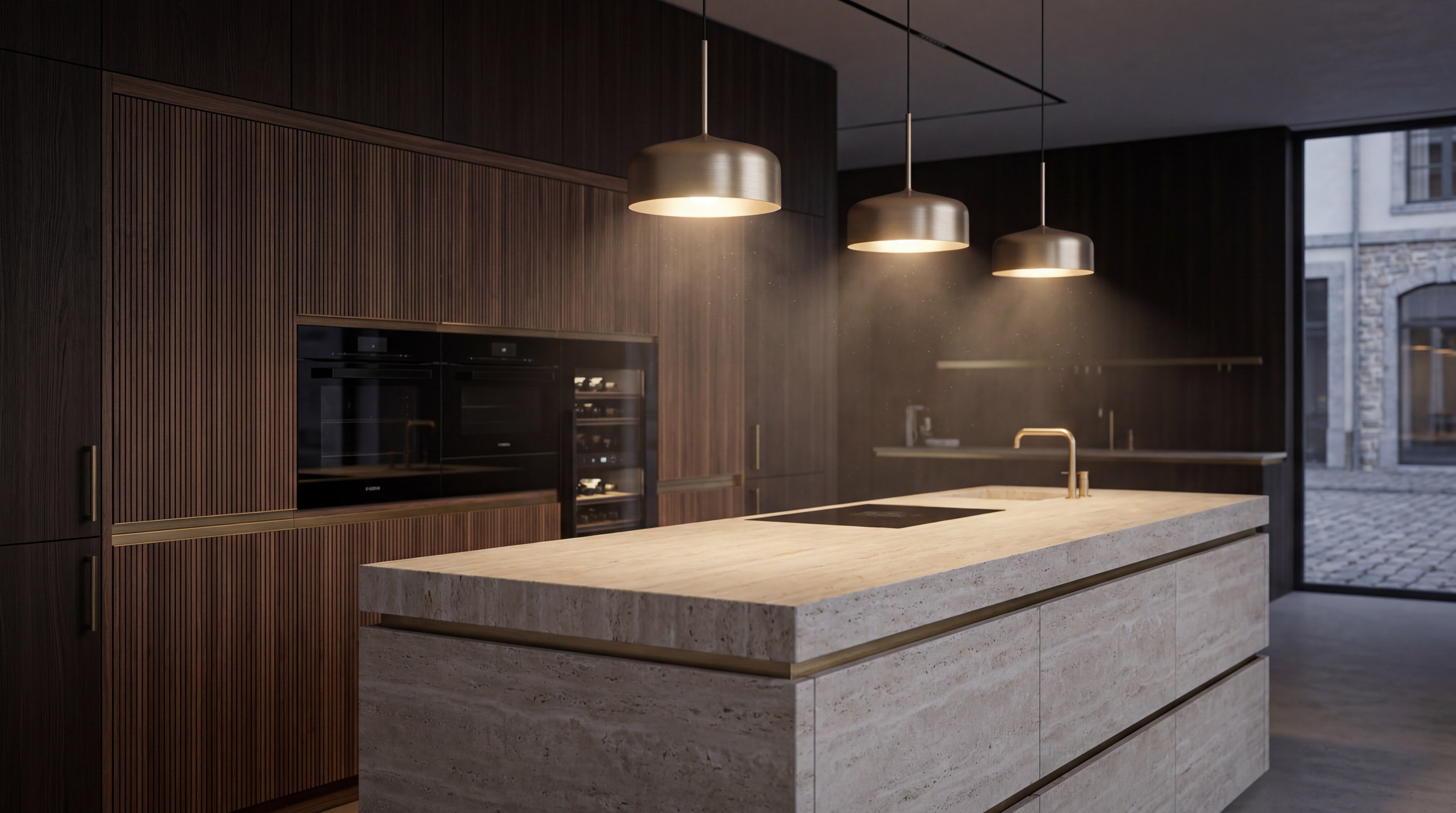
Three houses, three philosophies
Gaggenau traces its metalwork to the Black Forest in 1683 and it shows: the 400 series, with its solid stainless interiors and side-opening door, is closer to industrial sculpture than to a domestic appliance. It is the oven architects specify when the kitchen is conceived as architecture — flush, monolithic, uncompromising. The 200 series carries the same design language at a gentler level of investment.
Miele, family-owned since 1899, competes on completeness rather than provocation. The Generation 7000 ranges — from handleless ArtLine to the classic PureLine — pair conventional, steam and speed ovens with the most developed automation in the category: guided programmes, precise climate control, and details like automatic door-opening at the end of a bake to stop residual heat overcooking a crust.
Wolf is the domestic descendant of American professional kitchens, built alongside Sub-Zero in Wisconsin. The M series ovens use twin vertical convection fans for aggressively even heat, and the brand’s signature red knobs and heavy-gauge construction bring genuine range-cooker theatre into a fitted kitchen. If your cooking leans toward roasts, searing and volume entertaining, Wolf speaks your language.
How they cook
In everyday use the differences are real but subtle. Gaggenau’s strength is precision at the extremes — the 400 series holds low temperatures with laboratory steadiness, and its combi-steam ovens (a category Gaggenau helped pioneer for the home) are the reference for bread, fish and long slow work.
Miele’s strength is repeatability. Its sensor-driven programmes genuinely work: the same loaf, the same roast, the same result, every time, with less attention from the cook. For a household where several people cook at different skill levels, that consistency is worth more than any single headline feature.
Wolf’s strength is heat. The convection system recovers temperature faster than almost anything else when the door opens, which matters for high-volume roasting and baking in batches. It is the least automated of the three by design — Wolf assumes the cook wants control.
- Choose Gaggenau if…
- The kitchen is an architectural statement, you want combi-steam at reference level, and the appliance is allowed to shape the design rather than fit into it.
- Choose Miele if…
- You value consistency, automation and ecosystem breadth — and want the reassurance of the most established local service footprint.
- Choose Wolf if…
- You cook with fire and volume, love the professional idiom, and want an oven that treats you as the chef rather than the passenger.
Deciding between the houses?
An hour with a senior consultant turns reading into a specification. Complimentary, and without obligation.
The South African questions
All three houses are established in South Africa, but their support models differ. Miele operates directly in the country, with its own service infrastructure — for many buyers that is the deciding factor. Gaggenau is supported through the BSH group and specialist dealers. Wolf is imported and supported through specialist channels; excellent, but a smaller network, so confirm service arrangements for your region before you specify.
Power is the other local reality. A large electric oven draws serious current, and none of these brands belongs on a small backup inverter. If your home runs a solar or battery system, tell your designer early — circuit planning for a 400-series Gaggenau or a Wolf dual-fuel range is not an afterthought. Our guide to induction, gas and load-shedding covers the wattage arithmetic in detail.
Finally: lead times. These are made-to-order instruments, and eight to sixteen weeks from order to Johannesburg is normal. The appliance decision should come before cabinetry is finalised — apertures, ventilation and services are designed around the ovens, not the other way round.
What they cost
All three houses are price-on-application in South Africa, and honestly so — final pricing moves with specification, series and exchange rate. As orientation only: a single premium built-in oven from any of these houses is a six-figure rand conversation once installation is included, with Gaggenau’s 400 series and Wolf’s larger pieces at the upper end. Our cost guide places the full kitchen investment in context.
The more useful comparison than price is value-per-ritual: a combi-steam oven you use daily outearns a second conventional oven you use at Christmas. Specify from your cooking backwards, not from the brochure forwards.
Frequently asked questions
Is Gaggenau better than Miele?
Neither is “better” — they optimise for different things. Gaggenau optimises for architectural presence and precision at the extremes; Miele optimises for consistency, automation and ecosystem depth. In blind cooking results they are both exceptional. The honest question is which kitchen you are building and who cooks in it.
Is Wolf available and serviceable in South Africa?
Yes — Wolf (with Sub-Zero) is imported and supported through specialist channels in South Africa. The network is smaller than Miele’s direct operation, so confirm service coverage for your area as part of the specification conversation.
What do these ovens cost in South Africa?
All three brands are price-on-application. Final pricing depends on series, configuration and exchange rate, and is confirmed through consultation. As an indicative planning matter, premium built-in ovens from these houses are six-figure rand purchases — see our Luxury Kitchen Cost Guide for how the full project typically bands.
Which is best for baking bread?
A combi-steam oven changes bread more than the brand does. Gaggenau’s combi-steam is the reference instrument; Miele’s steam range is outstanding and more automated; Wolf’s convection steam oven is excellent and the most intuitive for cooks who work by feel.
Can I mix brands — say a Wolf range with Miele ovens?
Yes, and well-specified kitchens often do: each house at its strongest ritual. The trade-offs are aesthetic coherence and multiple service relationships. A specification consultation exists precisely to compose this well.
Prepared and reviewed by The Kitchen Affair atelier · Johannesburg · Updated 7 July 2026